
Counterbalance Valve Applications in Telescopic Booms Explained
Counterbalance valve applications in telescopic booms sit at the center of safe high-reach motion. They are not just hydraulic accessories. They are control points that decide whether a boom lowers smoothly, holds position accurately, or drops dangerously after a fault.
That is why the topic matters across MEWPs, truck-mounted platforms, telescopic handlers, mobile cranes, and specialized lifting systems. In every case, the same question appears: how can a raised structure stay stable while loads, angles, wind, and operator inputs keep changing?
For HLES, this issue connects structural stress, hydraulic-lock behavior, safety compliance, and fleet uptime. In practical terms, counterbalance valve applications in telescopic booms influence both operator protection and equipment utilization, especially where downtime or uncontrolled descent can trigger severe financial and legal consequences.
Why telescopic boom control deserves closer attention
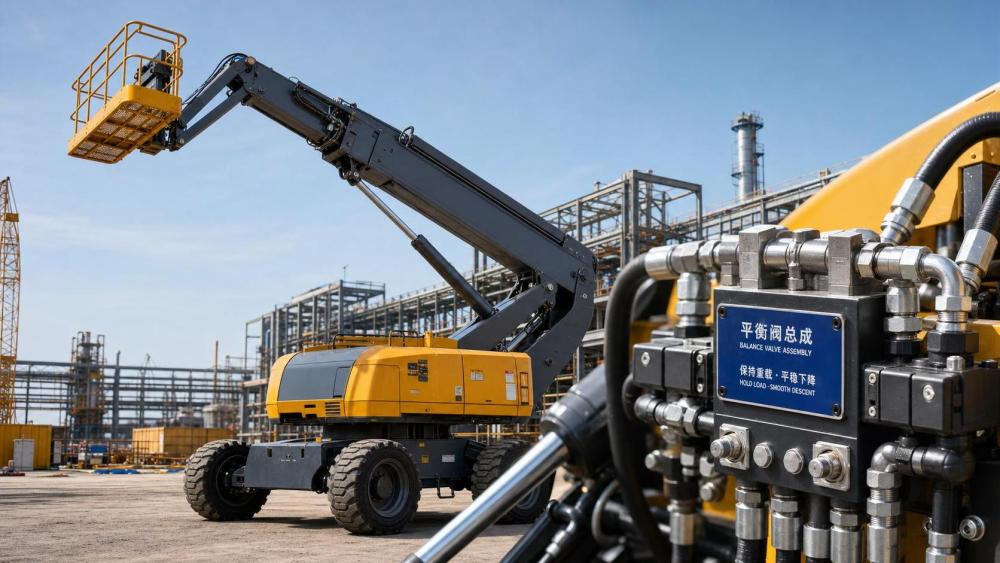
A telescopic boom changes geometry while it works. Extension length increases leverage. Load center shifts. Cylinder pressure changes with boom angle. The hydraulic circuit must respond without allowing bounce, drift, or free fall.
This becomes more critical in sectors now expanding quickly, including wind-power erection, urban infrastructure, plant maintenance, and high-level façade work. Higher working heights leave less margin for motion instability.
The industry also faces tighter expectations from ANSI A92, EN 280, rental fleet risk management, and site safety enforcement. A hose failure or poor load-holding event is no longer viewed as a minor hydraulic issue. It is treated as a system-level failure.
What a counterbalance valve actually does in a boom circuit
In simple terms, a counterbalance valve is a load-holding valve that prevents a boom cylinder from moving unless pilot pressure commands controlled release. It resists the load until the circuit is ready to lower it safely.
In counterbalance valve applications in telescopic booms, the valve is usually mounted near the actuator or integrated into a manifold. That location matters because the shorter the trapped oil path, the stronger the protection during a hose rupture.
The valve also helps manage overrunning loads. A descending boom can force oil out of the cylinder faster than the pump intends. Without control, the load can run ahead of the pump and create unstable motion.
A well-matched counterbalance valve converts that unstable tendency into predictable lowering. The result is not only safer motion, but also smoother positioning during work near structures, nacelles, steel members, or occupied platforms.
Where counterbalance valve applications in telescopic booms create the most value
The strongest value appears when boom movement combines elevation, outreach, and changing load moment. That includes both people-lifting equipment and heavy material-handling machines.
Typical equipment contexts
- Self-propelled boom lifts that need stable basket positioning during elevation and descent.
- Truck-mounted aerial platforms working on utilities, signage, and bridge inspection.
- Telescopic cranes where boom luffing loads interact with dynamic wind and structural flex.
- Telehandlers handling suspended or offset loads with changing extension length.
- Specialized maintenance machines operating in confined industrial or offshore environments.
Primary value points
- Prevents uncontrolled boom descent after line failure or sudden pressure loss.
- Improves load holding when the operator pauses at height.
- Reduces oscillation and jerking during lowering.
- Supports finer metering in load-sensing hydraulic systems.
- Protects fleet value by reducing shock-related wear and incident exposure.
The difference between basic holding and real motion control
Not every load-holding setup performs equally well. A valve can stop collapse, yet still create poor controllability. That distinction is often missed when evaluation focuses only on rated pressure or catalog terminology.
In advanced counterbalance valve applications in telescopic booms, tuning is as important as the valve type itself. Cracking pressure, pilot ratio, backpressure sensitivity, and spool response all affect lowering quality.
If the setting is too high, the boom may hesitate and then release abruptly. If it is too low, the circuit may permit drift or unstable descent. If pilot pressure response is inconsistent, micro-positioning becomes difficult.
This is especially relevant in HLES-covered sectors, where digital controls, telematics, and safety logic increasingly depend on predictable hydraulic behavior. Software can monitor risk, but the valve still determines the physical hold.
Common scenarios that shape valve selection
Selection should begin with the actual duty cycle, not with a generic pressure figure. Two telescopic booms with similar sizes may need different counterbalance strategies because their motion profiles differ.
This is where counterbalance valve applications in telescopic booms become an engineering trade-off. The best answer depends on whether the machine prioritizes human occupancy, lifting precision, harsh duty cycles, or rental standardization.
What to examine during technical evaluation
A useful review goes beyond asking whether a counterbalance valve is present. The real question is whether the total boom-lowering circuit behaves safely under both normal and fault conditions.
Key checkpoints
- Valve placement relative to the boom cylinder and exposed hose length.
- Pilot ratio suitability for the actual load range and cylinder geometry.
- Behavior during warm oil and cold-start conditions.
- Interaction with proportional valves, load-sensing pumps, and electronic controls.
- Emergency lowering logic during engine-off or power-loss events.
- Tolerance to contamination, pressure spikes, and repeated duty.
Field evidence matters too. Drift complaints, harsh lowering, and inconsistent stopping often reveal a mismatch between valve tuning and machine dynamics. Those symptoms should not be dismissed as operator feel alone.
How the broader industry context changes the discussion
The conversation around counterbalance valve applications in telescopic booms has widened. It now touches compliance, telematics, predictive maintenance, and life-cycle cost, not only hydraulic design.
Large rental groups increasingly want measurable proof of safety performance and machine availability. A boom that holds reliably after hose damage reduces incident risk. A boom that lowers smoothly also reduces wear, callbacks, and out-of-service time.
For intelligence-led platforms such as HLES, this makes the valve a strategic component. It links fluid mechanics to fleet economics, because safer and more predictable motion supports utilization targets as much as it supports compliance records.
A practical way to move from interest to decision
The most effective next step is to map the boom application before comparing valve options. Start with the machine’s highest-risk motion, then review failure modes, lowering quality, and integration with the rest of the hydraulic architecture.
From there, compare real operating data against design assumptions. If a machine works in gusty sites, high-cycle rental service, or high-precision lifting, those conditions should shape the acceptance criteria.
Counterbalance valve applications in telescopic booms are best understood as a control discipline, not a checkbox. The more clearly the duty cycle, safety threshold, and motion expectations are defined, the easier it becomes to judge whether the chosen valve strategy is truly fit for service.
That approach creates a stronger basis for specification review, supplier comparison, test planning, and long-term fleet standardization without reducing the issue to simple pressure ratings or generic load-holding claims.
Related News
- How anti-collision radar supports tower crane safety complianceSep 22, 2026Rental Capital & IoT Strategist
- What to assess before choosing crane drive systems in CanadaSep 21, 2026Structural Rigging Architect
- How rental telematics can reduce idle time for aerial equipmentSep 20, 2026Rental Capital & IoT Strategist
- How CAN-bus control modules improve scissor lift fault diagnosisSep 19, 2026MEWP Safety & Human Factors
- How a fleet uptime management dashboard helps prevent missed maintenanceSep 18, 2026Rental Capital & IoT Strategist
- Wind turbine crane safety practices for lifting in high windsSep 17, 2026Heavy Kinematics Scientist